There's a number most hotel finance teams don't know. Not because it's hidden, but because the process that would surface it isn’t in place… yet.
For a typical 300-room hotel, OTA mis-reconciliation was found to quietly remove $130,000+ in direct revenue leakage and another $300,000 in ratings-related future revenue every single year. That's $430,000 leaving through a gap most operators have accepted as the cost of doing business with OTAs.
It's not. And it's not inevitable. The Evention Platform includes the OTA Recon module specifically because this problem is systemic, but these problems also have have systemic solutions. Trust After Checkout isn't just a tagline. It's a standard that says: every reservation should be validated, every component confirmed, every day.
This blog breaks down all six ways the leakage happens, with real scenario examples, so you can see exactly what it looks like when it hits your books.
Why This Keeps Happening
One reservation touches seven systems:
Guest → OTA → Channel Manager → PMS → Payment Processor → Bank → General Ledger.
Every one of those handoffs is an opportunity for the numbers to diverge. An OTA records a rate. A channel manager routes the reservation. The PMS records a room and fees. A payment processor handles the settlement. A virtual credit card funds the hotel. Finance tries to reconcile all of it after the fact — usually at summary level, usually by checking whether the totals arrived.
Close confirms totals. It does not confirm correctness.
That's the gap. When reconciliation happens at the summary level, sub-threshold discrepancies, anything below your investigation threshold of $25, $50, $100, get written off. Quietly. Permanently. Across hundreds or thousands of reservations a year.
The six scenarios below are the most common ways that gap gets exploited. None of them are malicious. And all of them are preventable, but only if you're validating at the reservation level, not the summary level.
SCENARIO 1 OF 6 VCC Underpayment
When the Virtual Card Doesn't Match What the Guest Actually Paid For
OTAs often pay hotels through virtual credit cards (VCCs), single-use cards funded to cover the guest's stay. The OTA issues the card, the hotel charges it at checkout, and the transaction is supposed to settle cleanly.
Here's where it breaks: the VCC is issued at the time of booking, based on the original reservation. When something changes, a guest checks out early, shortens their stay, or modifies their booking, the OTA doesn't always update the card funding accordingly.
The most common pattern: a guest books three nights and checks out after two when it is outside of the cancellation/change window. The OTA funded the VCC for three nights. The hotel settles for two, but the card had a contractual right to collect for 3 nights. Without transaction-level validation, no one catches it. The variance sits below the review threshold and gets written off.
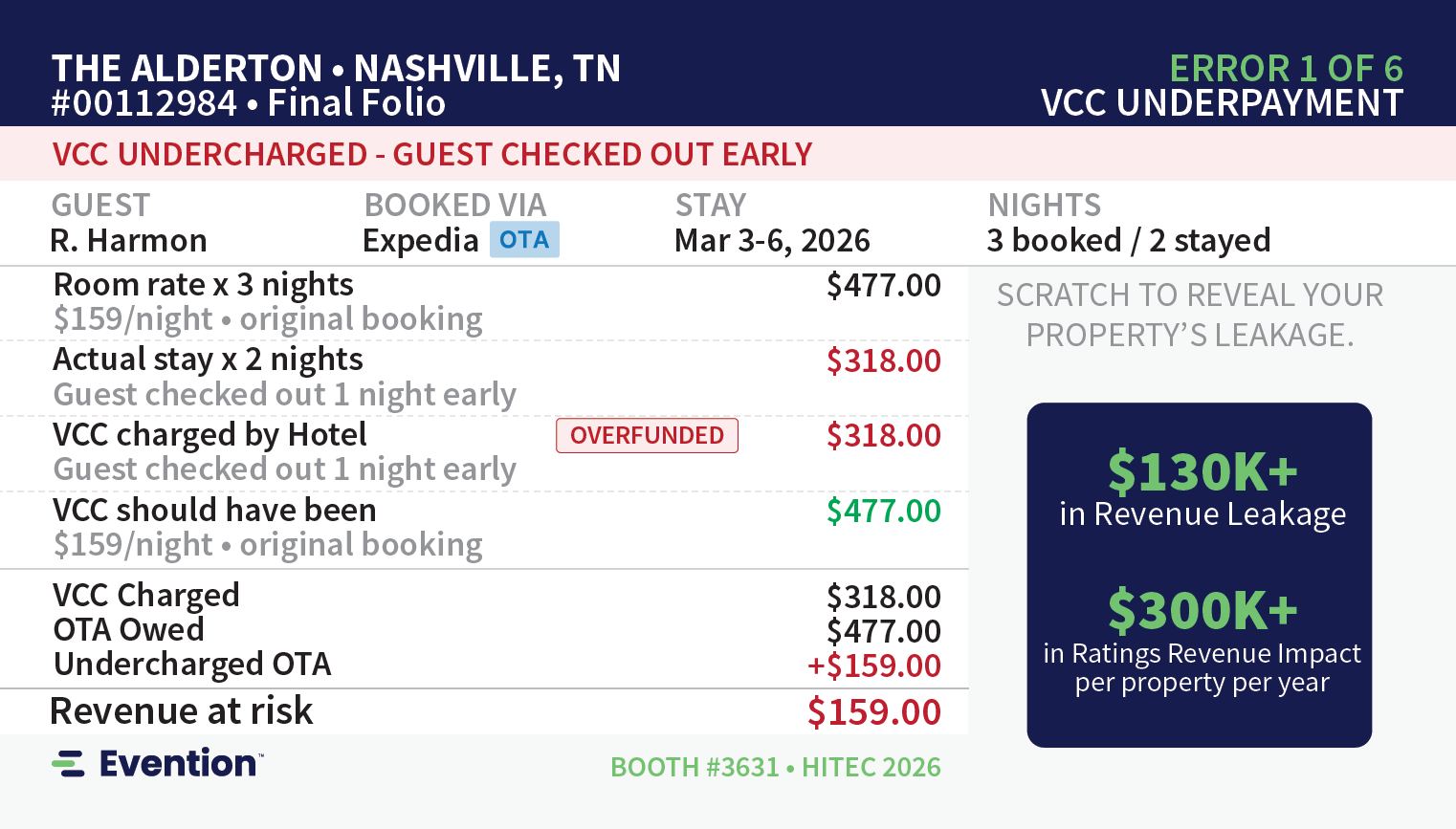
Why it matters at scale: VCC underpayments affect 90% of properties according to Evention client data. A $159 variance on one reservation is nothing. Across 1,000 reservations a year, it's $159,000.
The fix isn't chasing individual VCCs. It's automating reservation-level matching so every deviation surfaces automatically, while the dispute window is still open and the guest is still on property.
SCENARIO 2 OF 6 Commission Overpayment
When You Pay Commission on a Stay That Never Happened
OTA commission is calculated as a percentage of the booking value. The rate varies by OTA, contract tier, rate type, and sometimes by market. When the commission logic works correctly, it's a predictable cost of distribution. When it doesn't, it becomes a recurring hidden drain.
The most dangerous version of this error: Paying commission on a cancelled reservation. Here's how it happens. A guest cancels their booking with the hotel, but the OTA is not updated. Now there is a status mismatch between the OTA reservation and the PMS reservation causing the hotel to still pay a commission on a reservation that was technically cancelled, reconciling against their billing cycle invoice data, processes the commission as though the stay happened.
No flag. No alert. No recourse; because by the time it's discovered, the dispute window has closed.
In the scenario below, this isn't a small error. Three rooms, eight nights at a 15.4% commission rate produces a $1,480 overpayment on a single reservation that never generated a dollar of revenue.
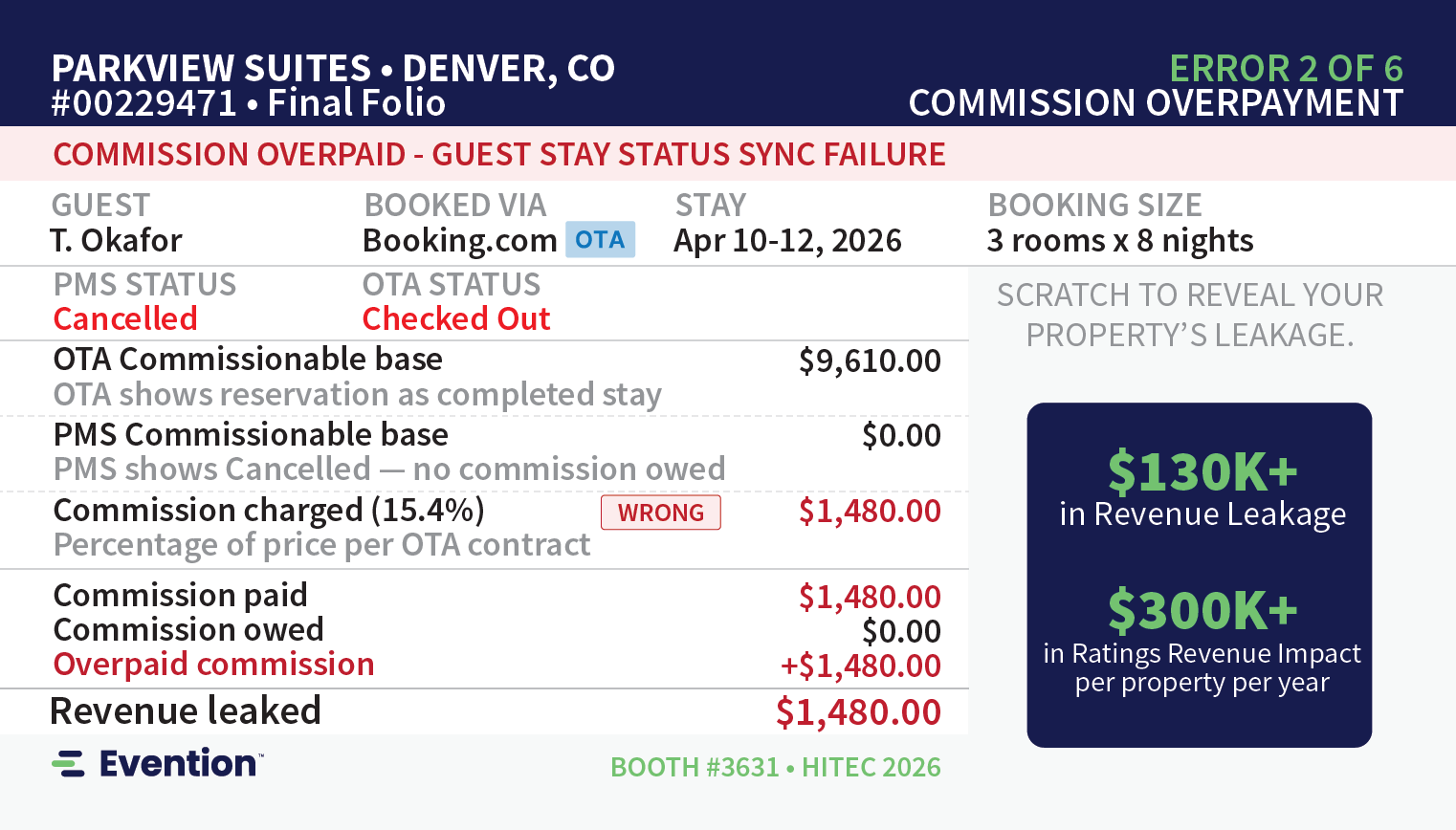
The larger pattern: commission disputes with OTAs have strict timelines. Late discovery, which is the norm under summary-level monthly reconciliation, means the money is gone even when you're right. The Evention OTA Recon module catches status mismatches in daily validation, surfaces the discrepancy before the dispute window closes, and generates the evidence needed to recover the overpayment.
76% of properties have commission overpayment exposure in their current OTA portfolio. Most don't know which reservations.
SCENARIO 3 OF 6 Room Rate Variance
When the OTA Extranet and Your PMS Don't Agree on the Rate
Rate disparity is one of the foundational principles of OTA distribution. The rate the OTA displays to the guest should match the rate in your PMS. In practice, they diverge constantly, and when they do, the VCC gets funded at the wrong rate.
How it happens: a property updates its rates in the PMS. The update pushes to the channel manager. The channel manager pushes to the OTA. But the push doesn't always complete cleanly, a timeout, a sync error, a rate category that didn't map correctly, and the OTA extranet continues showing a stale rate.
The guest books at the rate the OTA shows. The OTA funds the VCC at that rate. Finance reconciles the VCC receipt and assumes it's correct. The rate discrepancy between PMS and OTA extranet never surfaces.
In the scenario below, a $229 PMS rate versus a $649 OTA rate across three nights produces a $38 gap. Not dramatic. But repeat it across 300 reservations a year and it's $11,400, all below investigation threshold, all writing off silently.
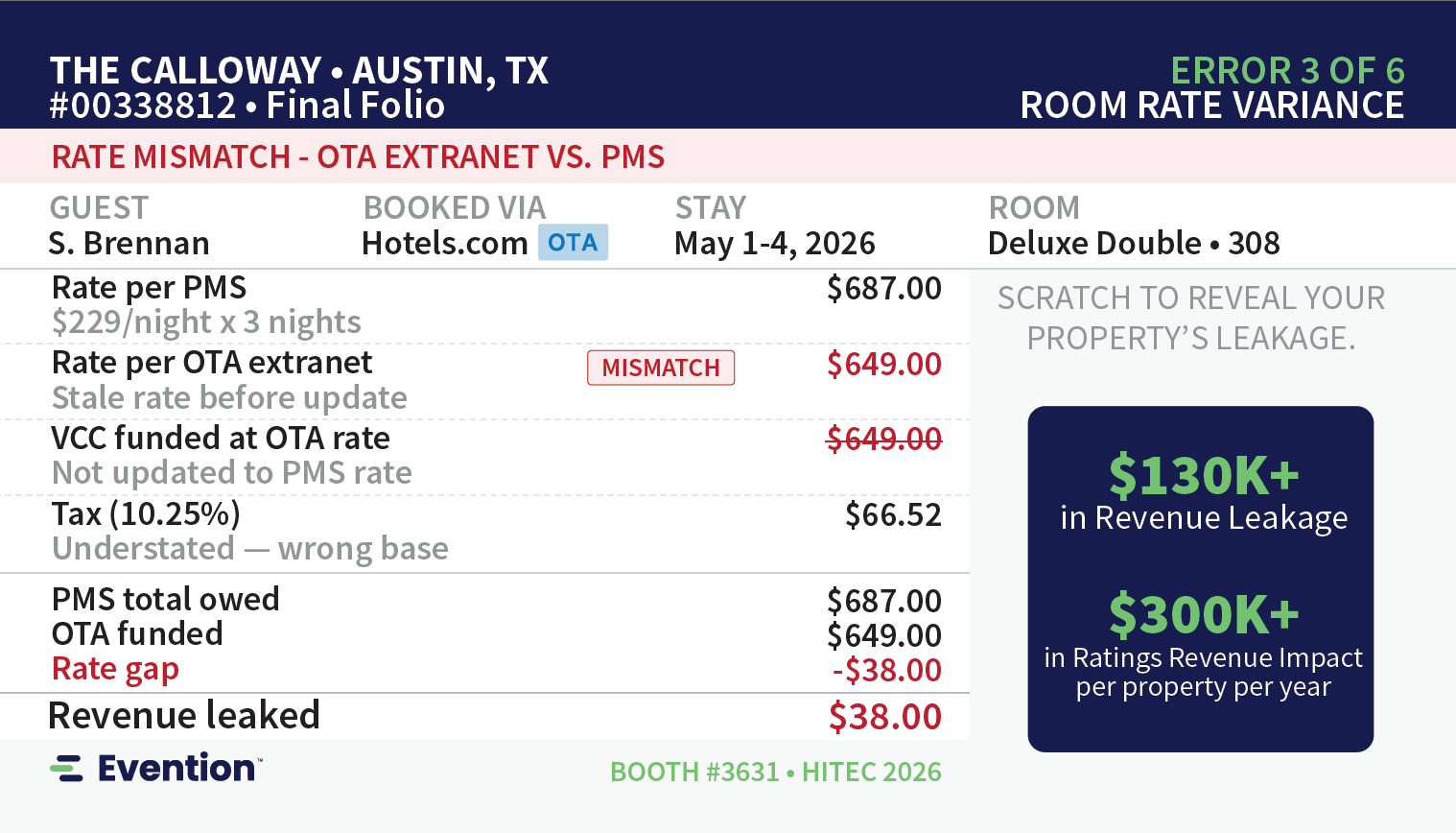
What makes this particularly difficult to catch manually: The amounts match within each system. The PMS shows the correct rate. The OTA extranet shows a different correct rate. Finance is reconciling two systems that each believe is right. Only transaction-level matching across both sources simultaneously surfaces the variance.
This is exactly what the OTA Recon module does, it doesn't check the PMS against itself. It checks the PMS against the OTA feed against the VCC payment, reservation by reservation, every day.
SCENARIO 4 OF 6 Resort Fee Leakage
When the Same Fee Gets Charged Twice, and Nobody Notices
Resort fees are one of the most contentious line items in hotel billing. OTAs handle them inconsistently: some bundle them into the displayed rate, some break them out separately, some pass them through to the hotel for collection, and some handle them entirely themselves.
That inconsistency is where the leakage lives. When a property's front desk adds a resort fee at check-in without checking whether it was already bundled in the OTA rate, the guest gets charged twice. The property has collected revenue it isn't entitled to. And when the guest disputes it, which they will the property faces a chargeback, a review, and a service recovery conversation that should never have happened.
The scenario below: A guest books an all-inclusive rate on Expedia. The $299/night rate already includes a $45/night resort fee. The front desk, operating from standard check-in procedure, adds the resort fee to the folio. The guest is charged $90 they already paid. They may not catch it immediately, but when they review their credit card statement three days after checkout, they will.
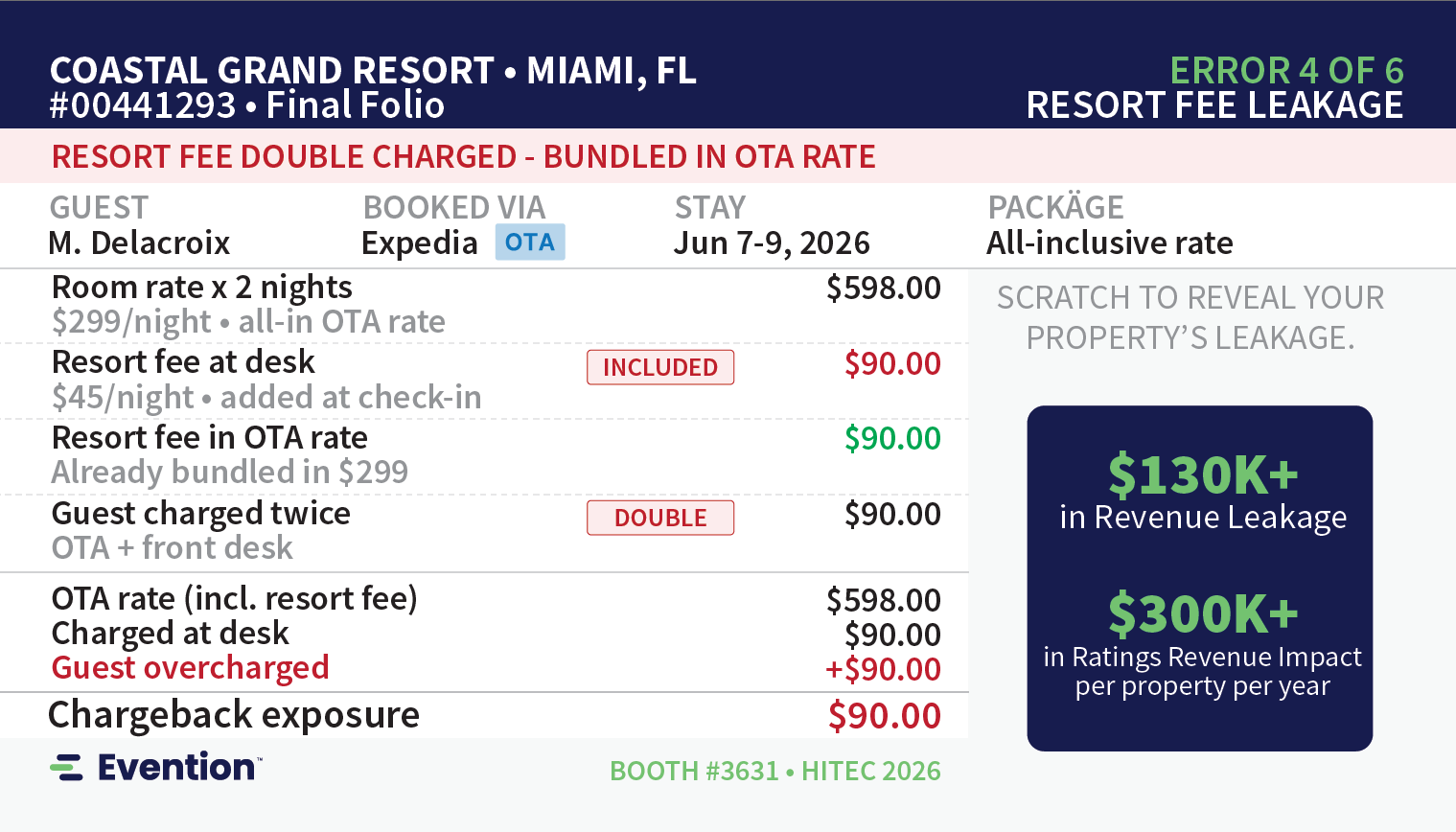
This is a financial error and a guest experience failure at the same time. The HSMAI Distribution Study 2024 found that billing errors account for 18–23% of negative OTA reviews. A $90 double charge becomes a one-star review. A one-star review suppresses future bookings. According to Cornell CHR research, a one-point reputation increase translates to a 0.89% ADR lift, the inverse is also true.
The $90 double charge isn't $90. It's $90 plus the chargeback fee, plus the estimated ADR impact across every future traveler who reads that review and books somewhere else.
SCENARIO 5 OF 6 Guest Overcharge
When the Front Desk Charges the Guest Card and the Virtual Card.
This is the error with the most immediate guest impact, and the one most likely to generate a review, a chargeback, and a service recovery escalation that consumes staff time for days.
For OTA bookings paid through virtual credit cards, the guest has already paid. The OTA collected payment, issued a VCC to the hotel, and the VCC is the hotel's payment instrument. The guest's physical card is on file for incidentals only, it is not a payment card for the room.
When a front desk agent runs the guest's card at check-in without checking for a VCC, both the VCC and the physical card get charged. The guest is billed $498 they already paid. The hotel has collected double revenue it can't keep.
The operational cause is almost always a training or process gap, a front desk agent who doesn't know to check for VCC status, or a system that doesn't surface the prepaid flag clearly at check-in. The financial and guest experience consequences are anything but small.
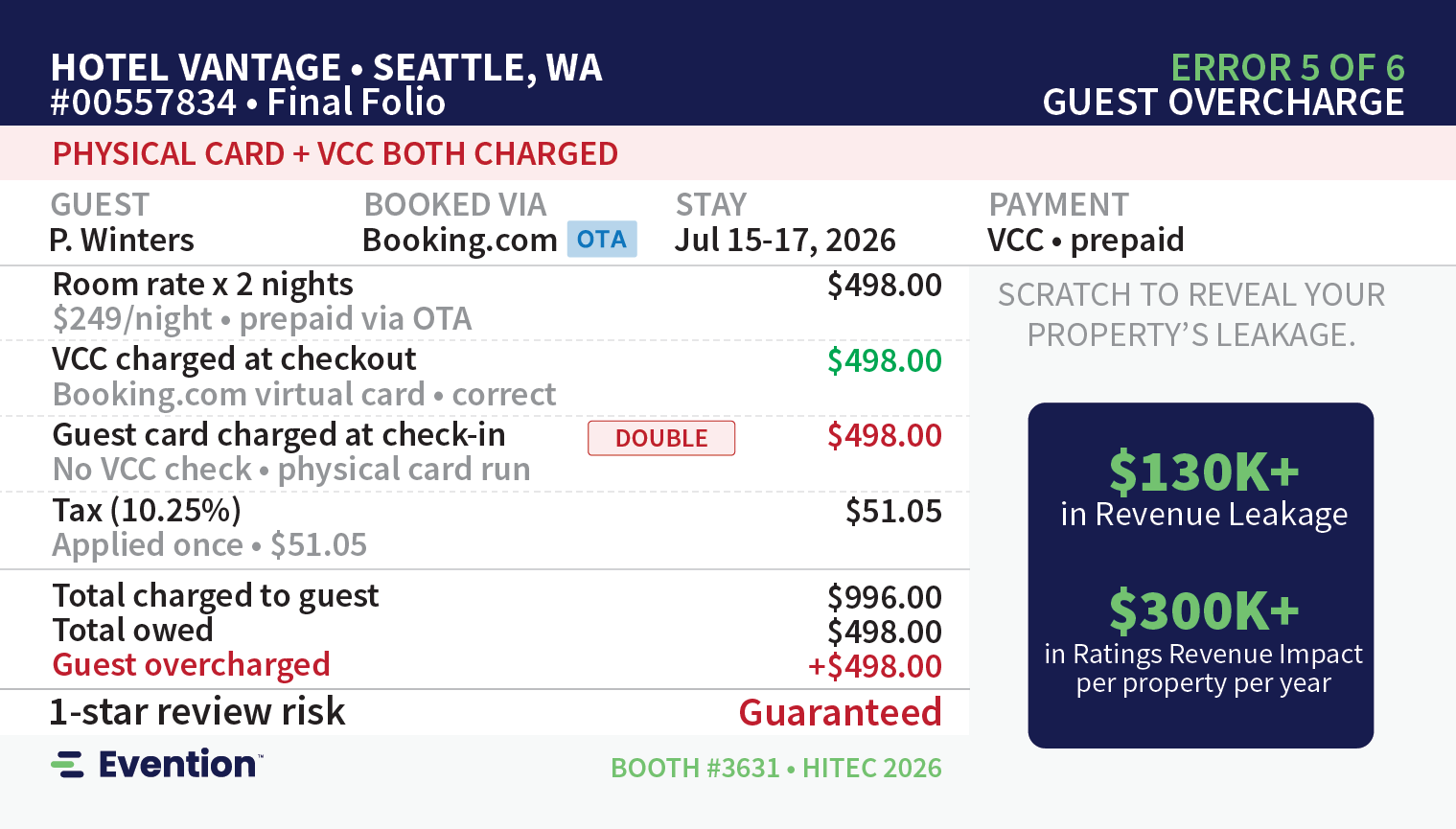
In the scenario above, daily automated validation would catch this before the guest checks out; while there is still time to reverse the charge, apologize in person, and prevent the dispute from ever leaving the property. The difference between catching it on day one and catching it on day thirty is the difference between a service recovery win and a public one-star review.
Every billing error is a potential review. Every review is compounding revenue loss.
The $498 double charge isn't just a refund. It's a chargeback fee. A dispute management cost. A one-star review that suppresses bookings for the next twelve months. And a guest who will never come back.
SCENARIO 6 OF 6 Tax & Misc. Variance
When the Tax Base Is Wrong, and Nobody Finds Out Until the Audit
Tax compliance in hotel OTA transactions is genuinely complicated. Local occupancy taxes, state sales taxes, city levies, destination fees, all of them have different rules about what the taxable base should be. Should tax apply to the gross room rate? The net rate after OTA commission? The all-in rate including resort fees?
OTAs apply their own logic, and it doesn't always match local tax requirements. The most common error: the OTA calculates tax on the net rate (after commission) rather than the gross room rate. The hotel remits the lower tax amount, creating a shortfall against what local law requires.
Unlike the other five scenarios, tax variances don't always result in immediate measurable leakage. What they create is audit exposure. When a tax authority audits the property and finds that occupancy tax was calculated on the wrong base, consistently, across thousands of reservations; the liability can be significant. And because OTA tax logic is opaque and contractual, the hotel is often the one that owes the back taxes, not the OTA.
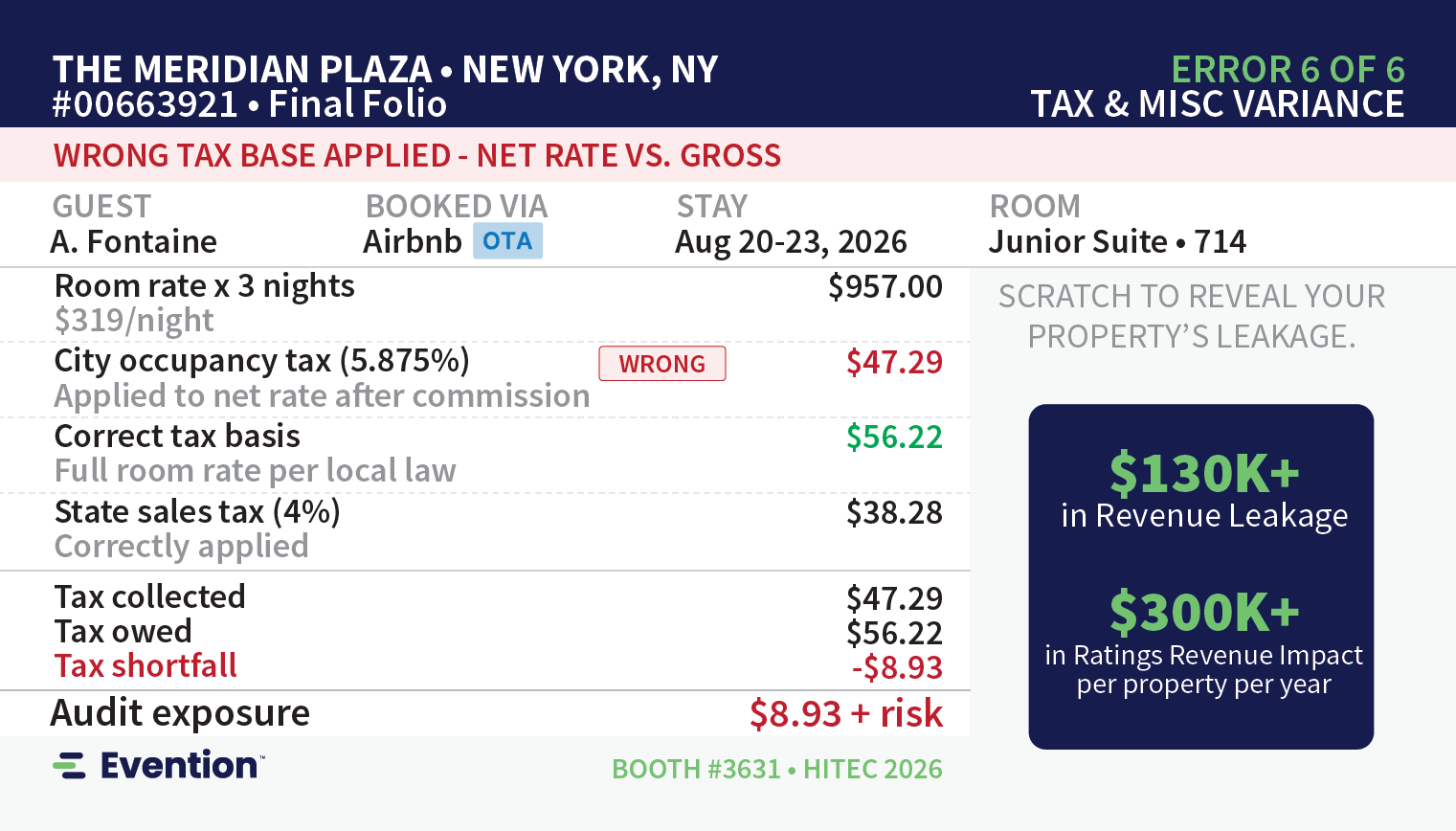
$8.93 per reservation. Across 500 OTA reservations per year, that's $4,465 in annual tax shortfall. Across five years before an audit, it's $22,325, plus penalties and interest. The shortfall per reservation is below every investigation threshold. The cumulative liability is not.
The Evention OTA Recon module flags these variances at the transaction level. Not at audit. Not at close. While there's still time to correct the remittance and build the audit trail that proves the correction was made.
The Combined Picture
Taken individually, each of these scenarios can feel manageable. A $38 rate variance. A $90 resort fee. A $159 VCC shortfall. Nothing that would stop a monthly close.
But these aren't isolated errors. They're systematic. They happen every month, on a percentage of every property's OTA reservations, across every OTA channel. The same root cause, reconciliation that validates totals instead of transactions, allows all six of them to compound silently until close confirms the numbers and locks them in permanently.
|
IMPACT CATEGORY |
PER PROPERTY / YEAR |
10-PROPERTY PORTFOLIO |
|
Direct Revenue Leakage |
~$130,000 |
~$1,300,000 |
|
Ratings & Future Booking Impact |
~$300,000 |
~$3,000,000 |
|
Combined Annual Exposure |
$430,000+ |
$4,300,000+ |
What Trust After Checkout Actually Means for OTA Finance
Trust After Checkout is the standard Evention is built to deliver. Most teams treat checkout as the finish line, once a payment is processed, it's assumed to be correct. Most systems stop there.
OTA reconciliation is where that assumption breaks down most visibly. Seven systems touch one reservation. Each one holds a version of the financial truth. The only way to know which version is right is to validate them against each other, at the transaction level, every day and before the guest checks out.
The OTA Recon module does that automatically. It ingests OTA reservation data, VCC payment records, PMS folios, commission statements, and bank feeds, and matches them reservation by reservation, every day. Exceptions surface while dispute windows are open. Variances get flagged before they write off. Finance closes the month with confidence, not assumption.
The shift isn't from bad reconciliation to good reconciliation. It's from reconciliation that confirms totals to reconciliation that validates correctness.
That's the difference between a financial trust layer and a financial close process. One confirms totals. The other confirms what was right.
Learn more about the OTA Recon

Source: Evention client data and industry analysis. Leakage estimates based on 300-room hotel benchmarks. Cornell CHR / HSMAI Distribution Study 2024.